1. The Client
The client is a dynamic US-based mobile application designed to streamline the hiring process. They solve a
critical pain point in the American job market: speed. With a significant percentage of companies facing
delays due to lengthy background checks, this platform offers a portable solution that accelerates candidate
verification. Their business model relies entirely on speed, efficiency, and high availability.
2. The Challenge: "Paying for Lights in an Empty Room"
While the app was efficient for users, their backend infrastructure showed scope of improvement and
efficiency. As the user base grew across the US, so did the AWS (Amazon Web Services) bill—reaching a point
where infrastructure costs were eating into operational margins.
When we audited their system, we found the classic symptoms of "Cloud Sprawl":
- Idle Machinery: Load balancers were running constantly on instances that
weren't actually
processing traffic.
- Mixed Environments: Development (testing) and Production (live)
environments were
entangled, meaning they were paying "live server" prices for testing code.
- Database Waste: The databases were unoptimized, running inefficient
queries that cost more
money to process.
Essentially, they were paying peak prices for resources they weren't using.
3. The Solution: AI-Assisted Optimization
We didn't just want to "patch" the problem; we wanted to re-architect it for long-term savings. We utilized
Amazon Q, an AI-powered assistant, to accelerate our analysis of their infrastructure and identify
bottlenecks faster than manual auditing allows.
Our approach involved four key steps:
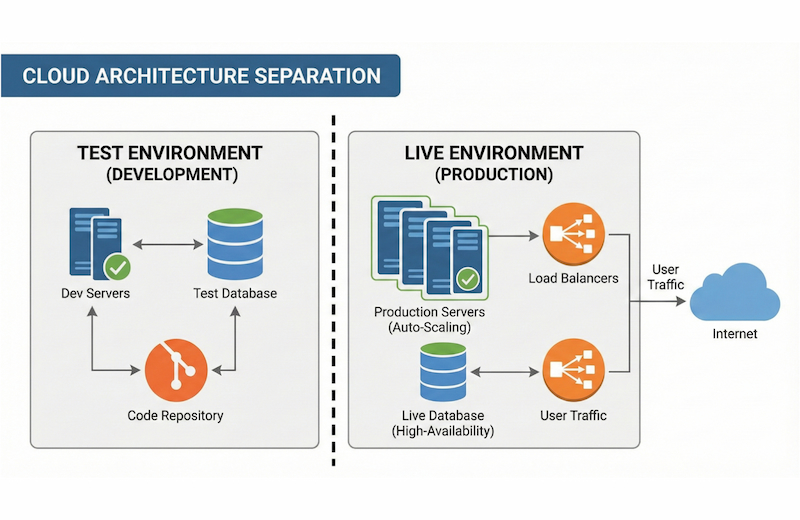
- Step 1: The Separation (Dev vs. Prod): We immediately created distinct
environments for Production and Development. This allowed us to turn off "heavy" resources in the
development stage when they weren't being used—something you can't do if everything is mixed together.
- Step 2: Right-Sizing the Fleet: We identified that the client was using
"Spot Instances" inefficiently. We moved them to Reserved Instances.
An example Scenario: Instead of paying a premium "hotel daily rate" for their servers, we switched them to
a "yearly lease," which instantly lowered the baseline cost.
- Step 3: Cleaning the Junk: We identified and terminated unused
infrastructure—specifically load balancers that were spinning but going nowhere.
- Step 4: Database Tuning: We optimized the database configurations to
ensure that data retrieval was fast and cheap, rather than slow and expensive.
4. The Results
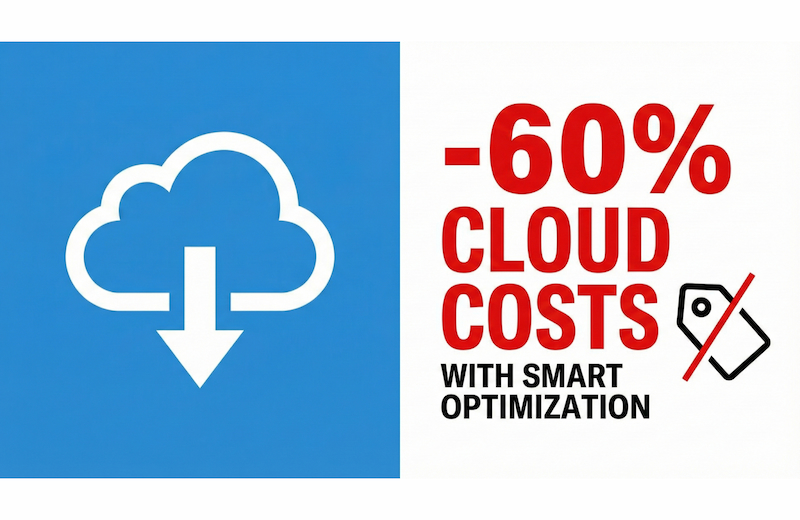
The impact was immediate and measurable.
- 60% Reduction in AWS Bill: By cutting waste and optimizing resource usage,
we more than halved the monthly infrastructure cost.
- Faster Optimization: Using Amazon Q allowed us to identify these cost
centers rapidly, delivering ROI to the client in record time.
- Scalable Foundation: The new architecture is not just cheaper; it is
cleaner. The client can now scale their user base without fear that their costs will skyrocket linearly.
- Conclusion: Cloud costs shouldn't be a mystery. With the right mix of
human expertise and AI analysis, we turned a financial leak into a streamlined, profitable operation.
Conclusion
Cloud costs shouldn't be a mystery. With the right mix of human expertise and AI analysis, we turned a
financial leak into a streamlined, profitable operation.